
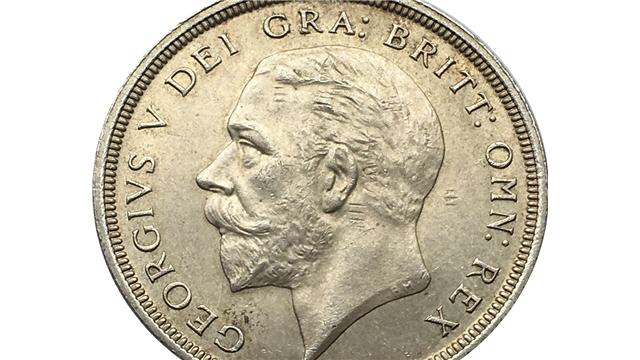
British coins reflect a nation with a very long history and traditions that take a long time to die. Using Latin inscriptions on coins is not anachronistic but a statement of who we, the British, are and hopefully will always be, reinforced by the effigy of Queen or King on the obverse and emblems of greatness, like Britannia, on the reverse.
History does take its toll; over the years we have dropped a few phrases. Britain no longer has an empire, colonies or is even a major influence in many countries. We rarely say ‘Great’ Britain. These days Britain is more often referred to as the ‘United Kingdom’. But coins give us, at the very least, an artistic licence to maintain a practice dating back more than 500 years.
Some Latin inscriptions phrases are still used on coins which are associated with Britain or the British Commonwealth, such as Canada.
What does the Latin Inscription on a modern British coin mean?
Modern coins are smaller in diameter than those of the pre-decimal era, a sign of the times that even non-precious metal is expensive, so the first thing to note is that the Latin inscriptions are actually Latin abbreviations.
For example, a coin of Elizabeth II would be as follows: On the obverse (‘heads’) the portrait of the Queen is surrounded by the text (called the Inscription or Legend):
ELIZABETH II : D G REG : F D
So we have:
ELIZABETH II
The British Monarch at the time, Queen Elizabeth the Second. Many monarchs use the Latin spelling of their names but not in all cases.
D G REG
An Abbreviation of DEI GRATIA REGINA, which means ‘By the Grace of God, Queen’. (A king would have D G REX).
F D
An abbreviation of FIDEI DEFENSOR, which means ‘Defender of the Faith’. The British Monarch is also head (Supreme Governor) of the Church of England. In the Church hierarchy, the Monarch is above the Archbishop of Canterbury. This subsidiary title was given to Henry VIII by Pope Leo X and the phrase has been used on coins since 1714 with the exception of a Florin in 1849 which was known as the ‘Godless’ Florin.
Many Commonwealth countries have dropped this phrase due to its association with the Christian Church. King Charles III has been reported as saying he would like the term to be ‘Defender of Faiths’ or 'Defender of All Faiths' rather than ‘Defender of the Faith’. Another example of how inscriptions can evolve in a changing World.
Older Coins
Prior to decimalisation, coins tended to have a much bigger diameter and so although the Latin inscriptions were as above they were not always abbreviated so much. As noted above, a few other phrases were used which have now lost favour. Consider a pre-war Penny of the 1930’s, it would read:
GEORGIVS VI : D G BR OMN REX F D IND IMP
(In passing you may have noticed that successive Monarchs face in opposite directions. This is just a tradition).
GEORGIVS VI
The Monarch then was King George the sixth. Note the spelling of the name is written in Latin. Some are more confusing, for example Carolvs II is Charles the second, Iacobvs II is James the second.
D G
Dei Gratia as before. All Monarchs rule with God’s Grace. Some coins use DEI GR or DEI GRA.
BR
BR or BRITT refers to Britain.
OMN
Omni means ‘All’ or ‘Every’. In context of the coin inscription it’s promoting the Monarch as Ruler of his subjects, ‘King of All Britains’.
REX
Rex means King (as Regina means Queen)
F D
As before, FIDEI DEFENSOR, ‘Defender of the Faith’.
IND IMP
IND is for India and IMP is Emperor, so we have ‘Emperor of India’. India became an independent nation in 1947 and the phrase was discontinued.
There are probably a few other Latin words, but these are the most popular.
 | Gibraltar 2017 One Crown 70th Platinum Wedding Anniversary Commemorative Coin £ 17.21 |
 | 1890 Victorian Crown F (Fine) .925 Silver British Coin £ 44.38 |
 | Edward VII 1902 Crown Coin St George & Dragon Design, Uncertified £ 113.94 |
 | 11 Coin Pre Decimal Set of UK Coins Crown to Farthing Inc Silver Threepence £ 11.95 |
 | Gibraltar 2015 Churchill Never Surrender One Crown RB BU 6284/9999 £ 14.00 |
 | Gibraltar 2017 WWI Centenary Battle of Ypres One Crown Proof Coin £ 11.86 |
 | 1887 Queen Victoria Jubilee Head Silver Half Crown, A/EF £ 80.00 |
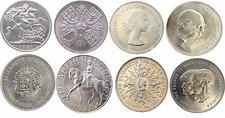 | FULL SET OF CROWNS FROM 1951 TO 1981 8 COINS CROWN COLLECTION £ 14.99 |